Pilate and Jesus by Giorgio Agamben & Adam Kotsko
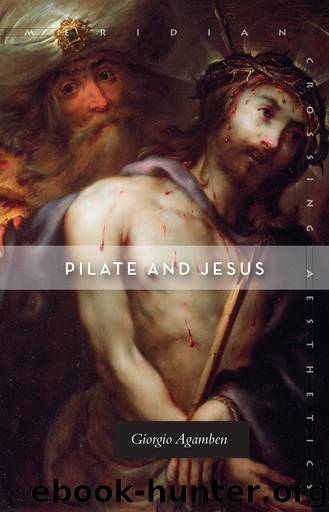
Author:Giorgio Agamben & Adam Kotsko [Agamben, Giorgio]
Language: eng
Format: epub
Publisher: Stanford University Press
Published: 2014-10-06T16:00:00+00:00
Glosses
א. The crossing between the temporal and the eternal has assumed the form of a trial, but of a trial that does not conclude with a judgment. Jesus, whose kingdom is not from this world, has accepted being submitted to the judgment of a judge, Pilate, who refuses to judge him. The debate—if it is a matter of a debate—lasted six hours, but the judge in the end did not pronounce his sentence, simply “handed over” the accused to the Sanhedrin and the executioner.
On the fact that a sentence was not pronounced, the narrative of the Gospels does not seem to leave any doubt. Matthew (27:26), Mark (15:15, 19:16), and John speak unanimously only of a “handing over.” The formula is identical in all three cases—paredōken, “handed over.” The verb epikrinō, which appears in Luke 23:24, is never used in a trial-related sense and means simply that Pilate “judged it opportune to accede to their demand (epekrinen genesthai to aitēma autōn; Vulgate: adiudicavit fieri petitionem eorum)”; immediately after, the formula is once again the same: “He handed over (paredōken) Jesus to their will” (23:25), where the will is therefore that of the Sanhedrin and not his own, which has not been expressed. Among ancient commentators, only Augustine seems to notice the curious conciseness of the formula “handed over,” and by doing violence to the text, he seeks to interpret it as if it implied a judgment on the part of Pilate: “It was not said: ‘He handed him over to them so that they may crucify him,’ but ‘so that he may be crucified (ut crucifigeretur),’ that is, that he might be crucified by the judicial sentence and power of the governor. But it is for this reason that the evangelist has said that he was delivered to them, that he might show that they were implicated in the crime from which they tried to hold themselves aloof; for Pilate would have done no such thing, save to implement what he perceived to be their fixed desire” (116.9) It is superfluous to observe that the passive “that he may be crucified” does not permit any inference either with respect to a judgment on the part of Pilate or about the identity of the responsible parties.
The traditional interpretation of Jesus’s trial must thus be revised. A trial—even if, perhaps, in the irregular forms of the cognitio extra ordinem—has taken place, but the judge has not handed down a sentence; there has not been any judgment in a technical sense.
But what is a trial without a judgment? The trial, jurists remind us, is always and only processus iudicii; it coincides with the judgment, with the krisis in which it is necessarily resolved. “The judgment,” a great scholar of trial law has written, “is not a goal external to the trial, because the trial is nothing other than a judgment and a formation of a judgment.” A trial without judgment is therefore a contradiction in terms. This is so true that modern codes
Download
This site does not store any files on its server. We only index and link to content provided by other sites. Please contact the content providers to delete copyright contents if any and email us, we'll remove relevant links or contents immediately.
| Africa | Americas |
| Arctic & Antarctica | Asia |
| Australia & Oceania | Europe |
| Middle East | Russia |
| United States | World |
| Ancient Civilizations | Military |
| Historical Study & Educational Resources |
Cecilia; Or, Memoirs of an Heiress — Volume 1 by Fanny Burney(32562)
Cecilia; Or, Memoirs of an Heiress — Volume 2 by Fanny Burney(31959)
Cecilia; Or, Memoirs of an Heiress — Volume 3 by Fanny Burney(31945)
The Secret History by Donna Tartt(19103)
Sapiens: A Brief History of Humankind by Yuval Noah Harari(14393)
Leonardo da Vinci by Walter Isaacson(13341)
The Radium Girls by Kate Moore(12035)
Sapiens by Yuval Noah Harari(5375)
How Democracies Die by Steven Levitsky & Daniel Ziblatt(5224)
The Wind in My Hair by Masih Alinejad(5101)
Homo Deus: A Brief History of Tomorrow by Yuval Noah Harari(4923)
Endurance: Shackleton's Incredible Voyage by Alfred Lansing(4788)
Man's Search for Meaning by Viktor Frankl(4611)
The Silk Roads by Peter Frankopan(4538)
Millionaire: The Philanderer, Gambler, and Duelist Who Invented Modern Finance by Janet Gleeson(4482)
The Rape of Nanking by Iris Chang(4222)
Joan of Arc by Mary Gordon(4117)
The Motorcycle Diaries by Ernesto Che Guevara(4106)
Stalin by Stephen Kotkin(3973)
